Intro To Dual Line Sport Kites
Dual Line Sport Kites: Now You're Flying
I want to tell you about the first time I watched a skilled pilot fly a dual line stunt kite. The kite moved like it was alive. Loops, dives, precision stops, figure-eights set to music. I remember thinking: that's not a kite. That's an extension of a person.
Sharon and I have done formation flying together. Choreographed routines, two kites moving in sync across the sky to music. People stop walking and watch. They don't always know what they're looking at, but they know it's something.
That's what's waiting on the other side of picking up two handles instead of one.
A single-line kite goes up and stays there. Beautiful, relaxing, exactly what it's supposed to be. A dual-line kite goes where you tell it. You're not holding a string anymore. You're flying.
How steering works
It's more intuitive than it sounds.
You hold a strap or handle in each hand. Two lines of exactly equal length run up to the left and right sides of the kite. Pull your right hand back and the right side of the kite tilts toward you, catches more wind, and turns right. Pull your left hand back, it turns left. Hold one hand back and the kite loops continuously until you even your hands out again.
The mistake beginners make is overcorrecting. Big arm movements, hands swinging wide. The pilots who make it look effortless are doing almost nothing. Small flicks of the wrist. Hands close to the chest. Let the kite respond before you ask it for more.
Give it one afternoon. The feedback loop between your hands and the kite clicks faster than you'd expect.
Two kinds of dual-line kites
Framed delta stunt kites
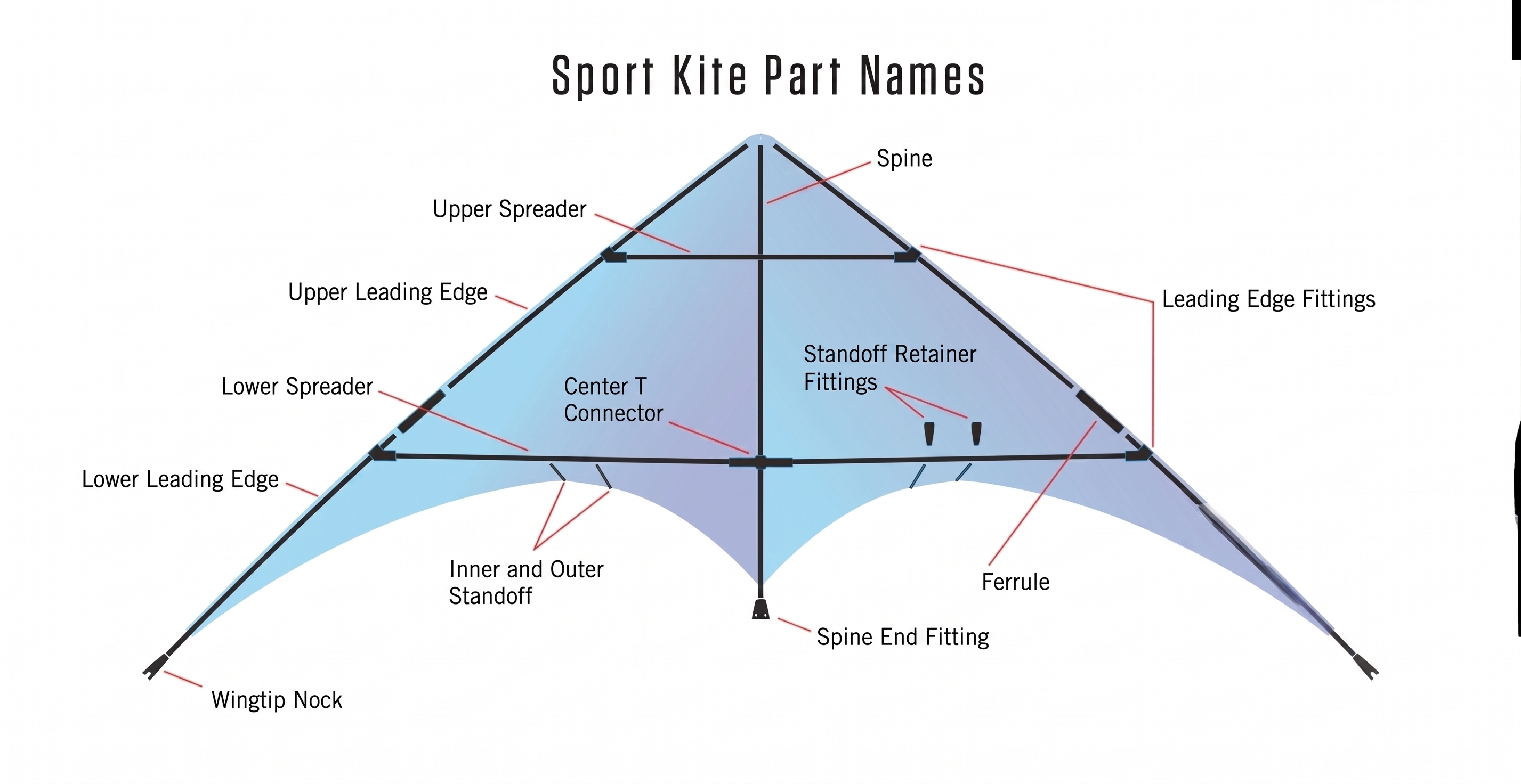
These look like miniature hang gliders. A rigid frame of fibreglass or carbon fibre gives them a precise, crisp feel in the air. Sharp corners. Fast response. When experienced pilots talk about tricks like axels, fades, and yo-yos, this is the kite they're flying.
The Aurora 48" Stunt Kite is where I'd send most beginners. It's designed specifically to teach the basics of steering and looping without punishing you for the learning curve. Once those fundamentals are solid, kites like the Prism Designs Synthesis and the Premier Kites Wolf NG open up a different level entirely. Ultra-light carbon frames, sail shapes engineered for slack-line performance. The kind of kites where you start to understand that the pilot and the kite are one system.
Dual line foil kites
No frame at all. The same principle Domina Jalbert invented in Quebec in 1964: fabric cells inflate with the wind to create an aerodynamic wing. Nothing to break, nothing to snap. If you crash a foil, you pick it up and fly it again.
The Mighty Bug 1.0 is a durable, well-made foil that packs down small and travels well. Good Dyneema lines included. A genuinely great first foil.
If you want to feel real pull, the HQ Kites Symphony Beach III 2.5m will give your arms a workout in a decent breeze. This is also the category that leads somewhere. People learning to kite buggy or work toward kitesurfing start here. A power foil teaches you to read and manage force before you strap into something bigger.
The wind window, revisited
We talked about the wind window in our getting started guide. With a dual line kite, understanding it properly matters.
The power zone is directly in front of you at ground level. The wind hits the kite face-on there. Maximum speed, maximum pull. The edges of the window, far left, far right, and directly overhead, are where the kite catches less wind, slows down, and loses power. A kite at the edge of the window will almost hover.
Use that. When you're ready to land, don't crash. Steer the kite all the way to the far left or far right edge of the window until it runs out of power. Walk toward it and let it settle onto the ground. Clean, controlled, no drama.
One thing you can't skip
Dual line kites require lines that don't stretch. If one line stretches even slightly more than the other, your kite will pull consistently to one side and you'll spend your afternoon fighting it instead of flying it. Quality sport kites use Spectra or Dyneema lines for exactly this reason.
Before every flight, lay both lines out and confirm they're exactly the same length. It takes a minute and it makes the difference between a frustrating session and a good one.
For attaching your lines, the Larkshead knot is what you want. Fast, reliable, the standard connection for kite flying. Full instructions on our Kite Knots page.
Fly a kite. Just for the health of it.
Bud Taylor and Sharon Musto, The Kite Guys